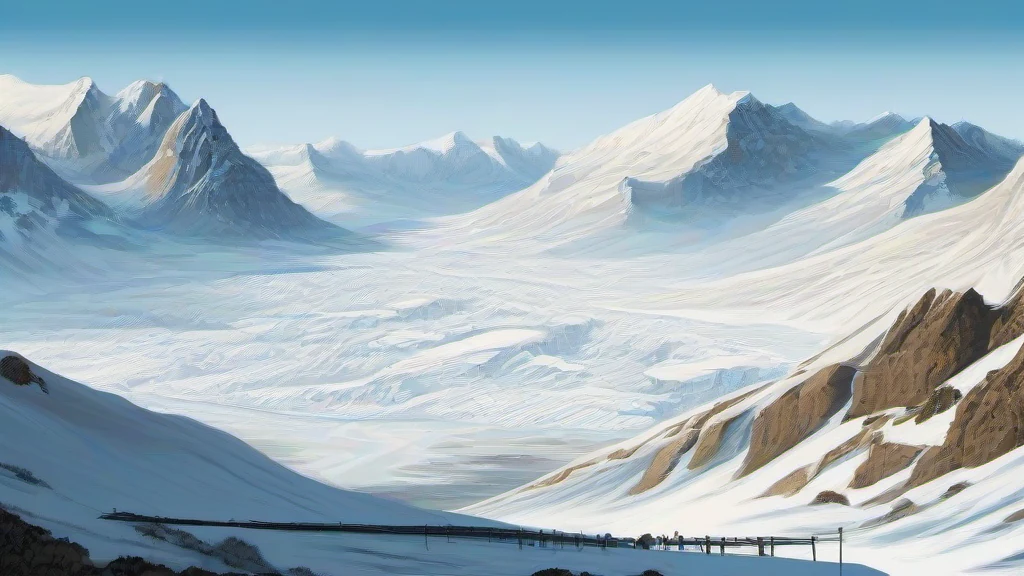
The glaciers of the Pyrenees are undergoing a rapid transformation, shifting from a landscape defined by perpetual ice to one dictated by increasingly hot summers. Data from the 2025-2026 campaign confirms that the last glaciers on the Iberian Peninsula are facing real-time extinction in an irreversible process expected to culminate in 2034.
Although the spring of 2026 brought abundant snowfall and record values by early March, a report published in late October by CryoPyr indicates that winter snow no longer serves as a shield against scorching summers. Consequently, the season closed as the third year with the highest ice losses since annual records began in 2012, surpassed only by the 2021-2022 and 2022-2023 campaigns.
To measure this decline, researchers have replaced old estimates with drones that generate high-resolution 3D models. By overlaying these models with previous years' data, scientists observed significant thinning. In Ossoue on the French side, the average loss was 3.1 meters in thickness, with some areas losing up to 4.9 meters. Other locations also suffered heavily; Aneto recorded an average loss of 2.4 meters, while Monte Perdido lost 2.3 meters on average, with local peaks reaching six meters.
Beyond thinning, the ice is fragmenting. The Aneto glacier, which was already divided in its eastern zone in 2025 and reduced to just 30 hectares, now faces further fragmentation into smaller sections. This is compounded by a darkening phenomenon where glaciers lose their dynamic flow and ability to expel rocks and sediments. As the ice surface darkens at the end of summer, it absorbs more solar radiation, accelerating its own melting.
A study published last year simulated this progression, determining that the Pyrenees will be ice-free by 2034. Even under moderate emission scenarios, Aneto is projected to lose 79% of its ice by 2030, with summers similar to 2022 potentially hastening this end.
Regarding water supply, the hydrological impact of these glaciers on regional river flows is now considered negligible. Their disappearance represents primarily a landscape, ecological, and symbolic tragedy rather than a critical issue for water provision.
Sources: Xataka.