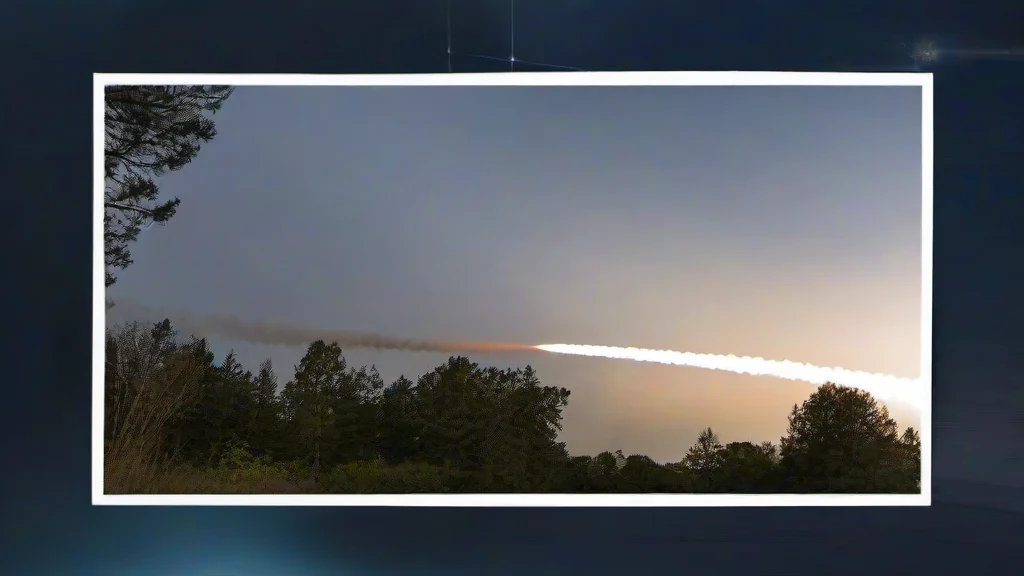
France’s SyLEx sounding rocket completed its second launch from the Defense Procurement Agency’s test center in Biscarrosse, in the Landes region, during the night of November 3–4, 2026. Unlike its November 2025 demonstration flight, this mission carried experimental payloads for the agency and the Ministry of the Armed Forces. Their exact nature was not disclosed.
Developed by ArianeGroup, SyLEx is designed to carry out suborbital experiments. On this flight, it crossed the conventionally defined boundary between the atmosphere and space at 100 kilometers, then continued on a trajectory that did not reach orbit. The agency and ArianeGroup did not release further details about the flight’s characteristics.
The experiments are intended to contribute to development of the M51.4, a future nuclear missile that has been in design since 2025. ArianeGroup was tasked with developing it in September of that year. The missile is expected to offer greater range and precision, as well as an improved ability to penetrate opposing defenses. The defense agency used radar and measurement equipment at Biscarrosse and Hourtin, along with the Monge test and measurement ship, to track the SyLEx launch.
The rocket flew in its single-stage configuration. ArianeGroup is preparing a two-stage version, with its first flight planned by 2027. The company says SyLEx can reach altitudes of between 140 and 400 kilometers, depending on the version. It lists payload capacities of up to 300 kilograms for the single-stage rocket and 600 kilograms for the two-stage version.
SyLEx is also intended for civilian customers, particularly in Europe, for microgravity experiments and atmospheric re-entry tests. ArianeGroup says experiments can experience four to five minutes of microgravity with one stage and more than six minutes with two.
French Armed Forces Minister Catherine Vautrin called the launch an advance for the country’s nuclear deterrence and said it enabled experiments essential to M51.4 development. The missile is expected to enter service during the next decade. ArianeGroup describes SyLEx as restoring France’s sovereign ability to conduct suborbital launches and high-atmosphere tests, a capability the country had lacked for several decades.
Sources: Numerama.